Welcome to the news section!
Here you will find all the news related to ATRIL and the translation market.
Qualities of a good translator
What makes a good translator? There’s definitely more to being a successful member of this profession than just language proficiency. What exactly are the qualities of a good translator that will make them stand out in the crowd? Below we discuss some of the characteristics that seems to be a prerequisite of a good-quality translation and a sign of professionalism. Would you add anything to the list?
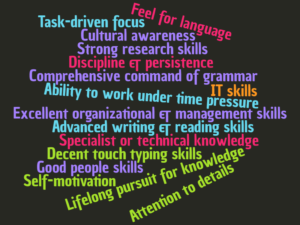
Top qualities of a good translator
#1. Language qualifications
For starters, a high level of language skills, although it’s worth pointing out that the emphasis is not only on proficient use of a foreign language, but also the native-language competence.
But there’s more – the ability to translate a text also requires the knowledge of the cultural context. A good translator must not only understand the source language perfectly, but also be able to detect all the nuances, ambiguities, humour or irony and transfer them from one language into another.
#2 Decent Writing Skills
Equally important, is to have excellent writing skills, as the ease to formulate thoughts into words comes in handy when translating both literary and technical texts. Readiness to experiment with words and an ability to express ideas in a concise way (especially when you are faced with word limitations) is also of great importance.
#3 Specialization
Another thing you can’t underrate is specialist knowledge, and that includes having a particular area of expertise. Some projects require detailed knowledge of a given subject, which is something not every translator can provide. While narrowing your services to one or a few areas of expertise may limit the potential number of clients, it can be beneficial in the long run. Having your own niche will send your prospective clients a signal that you’re an expert in your field. That’s definitely more satisfactory than focusing on more general translations. Plus, you won’t have to compete with a plenthora of other non-specialized translators.
#4 Knowledge of the industry
Specialist knowledge of a subject matter is important, but there are other factors you shouldn’t overlook. Some of the qualities of a good translator also include being computer savvy, having decent touch-typing skills, and a good command of CAT tools, especially if you’re planning on engaging in collaboration projects with other translators or working for a translation agency. Knowing your way around CAT tools can make you more competitive on the market and make you work more efficiently.
If you still haven’t had a chance to come to grips with any CAT tool, it’s high time! Give it a try with DVX3 Professional – test it completely free of charge for 30 days and then come back for more. Here and here, you can learn all about its features and functionalities.
#5 A thirst for knowledge
A good translator, no matter how successful, shouldn’t rest on their laurels. Instead, they should try to be up to date with the changes and innovations in the industry and their specialization field. Being open to new things will also make you more competitive and successful. Curiosity and eagerness to learn about new developments and innovations also shows you are serious about your career. Staying in the current may also help in building connections, and you can never undervalue the power of networking.
#6 Self-discipline and management skills
Specific personality traits are no less important, as delivering translations often involves working on tight deadlines, dealing with pressure and stress. That’s why good organizational skills and the ability to stick to a routine are a must.
Common mistakes of new translators
Translation is a profession that often gets undervalued not only by people unrelated to the industry, but sometimes even by aspiring translators only entering the profession. It is no piece of cake, especially if you’re thinking about going freelance. It’s because it takes much more than an impeccable command of a language to succeed in this field. What are some of the most common mistakes that translators make during the early stages of their careers?

Common mistakes of novice translators
#1 Agreeing to very low rates
At the start of their career, novice translators might feel tempted to start with lower rates in an attempt to land more jobs and gain valuable experience. However, the strategy of dumping your rates might prove counter effective and inefficient in the long run. You will end up having to take on too many projects to earn any decent money, which may take a heavy toll on the quality of your service. Another possible disadvantage is that it might hinder your work satisfaction.
#2 Being afraid to turn down a job
As a beginner, you might be reluctant to turn down a project, for fear of losing a client. But if you take up too much work or engage in a project that is outside your area of expertise, you may risk missing a deadline. This will likely harm your reputation and raise doubts about your professionalism.
#3 Lack of specialization
You might be tempted to think that by choosing a specialization, you will actively limit your possibilities and decrease the chances of reaching a wide clientele. It may mean you’d have to turn down projects outside of your area of expertise, but this approach might prove highly beneficial in the long run. Having a clear specialization will make you stand out and contribute to your image of a true professional. Money-wise this may also be a good decision, especially if your specialization is not very popular and you won’t have to worry about competition.
#4 Poor communication with clients
When you’re just starting out and don’t yet have a lot of experience, it’s important to try to maintain a good reputation. You can’t afford to have your clients wait for too long for an e-mail. Make sure you respond to all the communications promptly, so that your clients know you’re reliable and trustworthy. Never hesitate to ask questions when accepting a new project, especially when something is unclear and needs further clarification.
#5 Undervaluing the power of networking
The truth about freelancing is that you must make yourself seen (and stand out!), so that other people can hire you. Never underestimate the value of networking and try to find some time for marketing on a regular basis. It never hurts to join a professional organization or take interest in translator events and conferences. It will give you more credibility and a chance to keep current with the changes within the industry.
#6 Not using CAT tools
One of the common mistakes is not using any of the computer-assisted translation tools. Many new translators don’t realize how useful they can be. Using a CAT tool in your daily routine makes you faster and more efficient. It is also helpful in keeping all of your terminology consistent. It is a must if you want to stay competitive and/or are planning to work for a translation agency (some of them won’t even register you for work if you don’t use a CAT tool). If you’re still a translation student, you can benefit from Atril’s Academic Partnership and get yourself familiarized with Déja Vu free of charge. Dozens of universities across Europe have already joined the program. If you’re unsure whether a CAT tool is worth investing your money in, read out CAT tools-related myths.
Things to know before dating a translator
Are you considering dating a translator? Or maybe you have gone out with them already a couple of times? Translators are a great bunch: well-organized and with both feet on the ground on one hand and extremely creative and imaginative on the other. While it goes without saying that having a significant other who is a translator has its set of benefits, it comes with some issues too. The following post will help you realize what you’re getting into. And don’t say you haven’t been warned. 🙂

Things to consider before dating a translator
1). They can stay up all night… working.
Brace yourself: translators work around the clock. This is true especially of freelance translators. Irregular working hours seem to be a part of this job for way too many people. Be prepared for occasions when they have to cancel their plans at the last minute, work on a Sunday or until the morning hours, because of an urgent job that just came in or a tight schedule. On the plus side, translators can often take their time off when most people normally work and so they can help with running errands or other daily chores.
2) They are constantly on the work mode.
That’s just a fact of life: translators are working even if they’re not working. So, even when they are away from a computer, not actually typing in the translation, their mind is always going back and forth about a certain phrase, comparing, contrasting, looking for a better alternative. It can happen everywhere: while shopping, watching tv, during a casual conversation. Let’s face it, you’re dating a perfectionist – you can’t turn this off.
3) Translator =/= Interpreter.
Yes, they will expect you to know the difference and never use those interchangeably!
4) Translation =/= machine-translation.
That’s another pair you must never, ever confuse. If you’re serious about dating a translator, merely suggesting that what they do for a living is even remotely similar to what Google translate offers, is a big ‘’no, no”. Seriously, it’s one of the biggest misconceptions about translators and their work you might have.
5) They are coffee-powered.
This has a lot to do with points 1 and 2. Coffee is known to be a powerful stimulant, and since many translators tend to work a lot, they badly need it to stay alert. A cup of good, freshly-ground coffee can mean more than oxygen sometimes.
6) They will study restaurant menus in detail.
And not just to find something delicious to eat. Most translators love to hunt for the smallest mistakes in the menu. And for a good reason! If you look through some of the funniest restaurant menu translation fails, you can’t miss their point.
7) They will make you say goodbye to dubbed movies!
If you’re dating a translator, be prepared to watch movies only in their original versions, or pick those whose dialog track is not in your boyfriend/girlfriend’s target language. Otherwise you’re in for a long evening full of comments like: “That doesn’t even make sense!”, “That’s not what she said!”, “Who on earth would translate X as Y”, and the-likes. Whenever they come across a bad translation, a pun or another sort of language teaser, they would try to come up with an alternative translation trying to check whether would have done a better job themselves. And that’s just their work mode speaking again, which takes us straight back to the points 1 and 2.